
Archer BEX was born bet. October and December, 1851 in Croydon, London, Middlesex, England. He married Clara Ann WYKES bet. October and December, 1878 in Dartford District, Kent, England. He died 19 September 1883 in Erith, Kent, England. Clara Ann WYKES, daughter of Edwin WYKES and Sarah EVANS , was born bet. April and June, 1854 in Crayford, Kent, England. She died bet. July and September, 1936 in Bexley Heath, Kent, England.
| 1. Percy Vivian BEX, b. bet. October and December, 1879 | See Percy Vivian BEX & Blanch Ella WESTLEY |
| 2. Sydney Alfred BEX, b. bet. April and June, 1881 | See Sydney Alfred BEX & Annie MARTIN |
| 3. Archer Edwin BEX, b. bet. January and March, 1883 | See Archer Edwin BEX & Nellie Laura CHUTER |
Notes for Archer BEX:
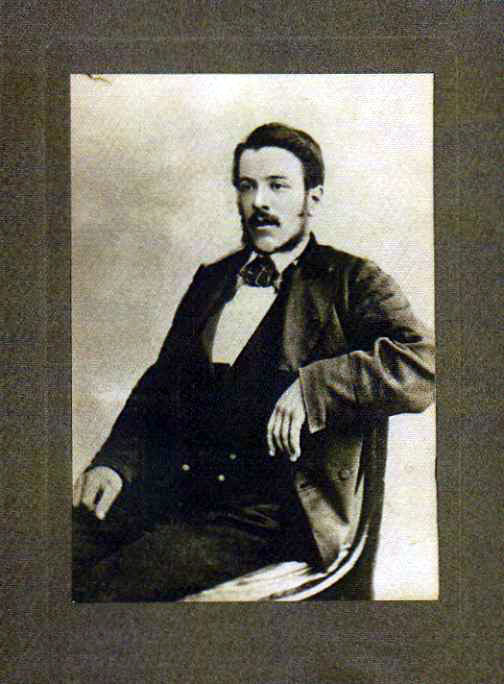
Archer Sr. in his 20's. (click to enlarge)
__________
In 1871, we see Archer living with his parents and siblings at Hall Place Hill, Bexley, Kent:
Alfred Bex Head Mar 41 Carpenter Arundel Sussex
Anna Eliza Bex Wife 40 Eblestead(?) Suffolk
Archer Bex Son UnM 19 Croydon Surrey
Laura Rose Bex Daur 12 Croydon Surrey
Grace Anna Bex Daur 10 Croydon Surrey
Minnie Kate Bex Daur 6 Bexley Kent
Herbert Maitland Son 1 Bexley Kent
Herbert Maitland is clearly identified as a son in the census but we have no explanation concerning his surname.
__________
Archer married Clara Wykes in 1878.
__________
In 1881, Archer is living at 4 Sandford Road, Bexley Heath, Kent:
Archer Bex Head Mar 29 Carpenter Surrey Croydon
Clara A Bex Wife Mar 25 Kent Crayford
Percy V Bex Son 1 Kent Bexley Heath
Sidney A Bex Son 1 mnth Kent Bexley Heath
David Macintosh Lodger UnM 18 Gardener Scotland
__________
Archer died in a fatal accident in 1883. The understanding is that he was travelling in a horse-drawn cart which was loaded timber. After turning a bend, Archer's tools slipped off the timber and in his attempt to save his tools. Archer fell and hit his head. He suffered a fracture to the base of his skill and died soon afterwards in hospital.
The following is an account of the enquiry into his death, as it appeared in the Erith Times, Abbey Wood Chronicle and General District Advertiser, Saturday 22 September, 1883:
Archer Bex, husband of Clara Ann Bex (nee Wykes)-- Fatal AccidentYesterday (Friday) an inquest was held at the Wheatley Hotel, touching on the death of Archer Bex, who met with his death on Wednesday last. The following gentlemen comprised the jury:- Joseph Henry Shaw (foreman) William Smith, Thomas Marshall, Francis William Selfe, Walter Hall, George Scales, Alfred Schofield, Thomas Jarvis, Thomas Coy, Thomas Field, Benjamin Sheppard, Horace Snowden and Sidney Collett Jones.
Mr. C. C. Ridley said he represented the relatives of the deceased and before the jury were sworn he wished the coroner to ask the jury whether there was one amongst them related to the driver.
Mr. Charles Cook’s name was mentioned and the coroner asked him to retire which he immediately did. Edwin Wykes, printer, was the first witness called, he said he resided at No.8 Collin’s Terrace, Bexley-heath, the deceased was his son-in-law, his name was Archer Bex, he was 31 last birthday. He followed the occupation of carpenter. He last saw him alive on Saturday when he walked across Bexley-heath with him. About quarter past eleven, Wednesday morning he heard that he had met with an accident James Miller, gentleman, was then called and stated that last Wednesday morning about nine o’clock he was in May-place-road on the left hand side, when he saw a cart come round the corner in front of him. It was a four wheeled open van. There were three or four men on the top, one had the reins in his hands, he was standing up. As they turned the corner he saw a man fly out of it. Could not tell the speed as it turned the corner very well but it seemed as if he was thrown out by the speed it turned. Witness went up to him immediately. The van stopped and the men got down. The man appeared to fall very heavily and he was insensible. He pitched onto his head in the road. They did not cut the corner fine but made a regular sweep. He saw some blood and afterwards went for a doctor and returned to the deceased who was still insensible, was afterwards removed in another van. He had had some experience in driving and he thought that the driver was, going too fast. In reply to the question put by the jury, witness said the wheel did not go over the curb. The driver was standing and the deceased was sitting at the time of the accident.
Re-examined by the coroner: There were no other vehicles about at the time to cause him to drive fast to get out of the way of anything. The planks were higher than the sides of the van.
By Mr. Ridley: Could not say whether there was anything he held on by. He could not say at what rate he turned the corner. He thought the driver was going too fast for public safety. Could not say whether his back or face was to the horses.
Charles Franklin, gardener, No 2 May villas, May-place-road, in the parish of Crayford, said he recollected seeing a man fall, but could not say whether it was Wednesday or Tuesday.
The coroner said he would take the next witness.
Robert James Vennils, labourer, of May-place-road, Bexley-heath, said he knew the deceased since a boy. On Wednesday, about 9’ clock in the morning, he saw deceased coming out of what he had always known as the Big Alley, opposite Mr. Clark’s beer shop, into May-place-road. Witness was coming down May-place-road at the time, from the market place, in the middle of the road, when he saw a four-wheel spring van laden with timber, 3 or 4 inches above the rail in the front part of the van. He observed four men on the van, one driving sitting on the side in the usual place, the deceased and Mr. Simmons were sitting abreast of each other on the fore part of the van. They had their backs to the horses. The other man was sitting behind in a similar position to the deceased. Could not say if the driver had the reins in his hands. He should say that they were going fast round the corner, but he should say the speed was about five or six miles an hour. He saw the deceased topple over sideways, on to the wheel and then on the ground. He clutched at his basket as witness thought to save himself. He pitched on his head in the road. It was the reaction of the van getting the straight road that caused him to fall. The deceased was insensible, blood was flowing freely from his left ear. There was a gentleman a few yards behind and he came up. He did not know his name but would recognise him if he saw him again. Took the deceased to Dr. Fahie and he advised his removal to the Cottage Hospital. He did not recover consciousness when going there. He did after arriving there and said "Oh, my head aches." Mr. Thomas Burton, jun, was driving the van. He was sober. He was usually a careful driver as far as he knew. Did not hear any calling out to hold on or anything. The deceased and Simmonds were sitting the way the timber laid and there was nothing to prevent them from falling if the wheel had caught the kerb. By Mr. Ridley: The timber protruded about 8ft. or 9ft. back or front. He thought the timber would sway. He did not think the deceased would have fallen if going slow. He had seen Mr. Burton trot round the corner before, but not with timber The owner of the van, who was in court, asked to be allowed to put a question to last witness, but the coroner said he could not permit it. James Simmonds, carpenter and joiner, of Rickard’s cottages, said he was with the deceased on Wednesday morning. He had been working with him that morning. He had known him fifteen years. Mr Burton put his horse to go to Crayford. Witness was to go. The cart was loaded with timber which was not tied. There was room for anyone to sit on the front of the van. Witness sat nearly sideways, looking to the offside of the back of the van. The deceased was sitting higher up on the timber with his back to the horse. The third man, Williams, was sitting lower down. Burton was sitting on the front of the van, on the off side, driving. Burton asked if they were all seated before he started. Could not account for the deceased falling. He heard some tools moving and then he saw the deceased falling over the side and the tools with him. They had got safely round the corner and were on the straight again. He had been driven by the same driver with greater loads safely. He felt a little sway but nothing unusual. He heard the deceased cry out "Oh" or "Whoa.’: He thought that Williams was the first to get down to the deceased, who was taken away. ‘The driver gave a good sweep else the battens would. have touched the wall. By the foreman: It is a very level road at that point.
Re-examined: He did not think the deceased was sitting in a proper position.
By Mr. Ridley: They took a wide sweep round the corner from the spot where they got perfectly straight, in about 15 ft.
Mr. Ridley How is it possible to take a wide sweep and get perfectly straight in the-same length as the timber. Witness: We were getting perfectly straight when the deceased fell off the cart. At the time he fell the van had got perfectly straight.
Mr. Ridley: if it was straight at the time of his falling off, how do you account for him falling of ? --I cannot say, unless he overbalanced himself. We were going from three to four miles an hour round the corner.
Mr. Ridley: Do you mean to tell us that it is a usual thing to trot round the corner at that rate? -Yes, he had seen Mr. Burton trot round and other men too with a similar load. Had not discussed the question with Mr. Burton. He heard someone call "Oh" or "whoa" but it was not distinct. He thought that it was perfectly natural he should call out under the circumstances. They were not obliged to sit in the position they did, there was plenty of room in the cart.
Daniel Williams, carpenter and joiner, said he lived at Bexley-heath and had worked for Mr. Burton a month that day. He recollected Wednesday. He went to breakfast at the usual time and on returning found a van loaded with battens and tools. Witness was directed to accompany them. The deceased was sitting in a line with witness, on the same plank. They took a slow trot round the corner--about the usual pace. He felt nothing more than the usual swing going round the corner. A noise of a falling saw first drew his attention and then he saw that the deceased was falling. Witness got down to the deceased at once. They had got on to the straight of the road when the deceased fell out. He thought deceased grasped at the tools and in doing so fell out of the cart. The deceased had been unwell. He was sober on Wednesday morning. By the foreman: Did not hear the deceased say anything.
By Mr. Ridley: It was the first time he had turned that corner. It was usual to turn at walking pace.
Charles Franklin said he believed the accident happened on Wednesday. He was sixty five yards off. He saw the man fall.
Thomas Burton, jun., in reply to the coroner said it was something of everything, did not know when to call himself. He Iived at No. I, Burton’s Cottages, Erith Road. (The coroner told witness he was not obliged to make any statement, but what he did state would be taken down in writing. Burton said he did not wish to say anything.)Mr. John Clarkson Maynard, F.R.C.S, said before half-past ten and eleven Wednesday morning, saw the deceased at the Cottage Hospital Erith. He was suffering from contusion, and incised wound 1.5 to 2 inches long on the right side of the skull and a few slight abrasions on other parts of the head. There was a great deal of hemorrhage from the ear and nose and twice during his last visit it came from his stomach. He was unconscious. He was treated in the usual way but he never rallied and died about four o’clock the same day. His opinion was that he died from fractured base of the skull consistent with a fall from a cart. He should say that he fell directly on to his head. The coroner told Mr. Burton, sen, that he was prepared to receive any statement bearing on the case but it must be on oath.
Mr. Burton said he could only say that there was a place provided for the man to sit.
The coroner, in summing up, reviewed the evidence given at some length; the evidence of the doctor was to the point --he attributed the death of the deceased to violence received to the base of the skull. The question was, how that was received. They had evidence that the deceased fell from the cart and the question was, how he came to fall. The evidence to be drawn from the evidence of one or more witnesses was that he was driven too rapidly round the corner, of course if that was so it showed negligence on the part of the driver; but it was not as he thought to accept inferences in all those cases. On the other hand, if the driver took all ordinary cautions he could not be held responsible. He did not wish to hurry the jury to a decision, but to take their own time in arriving at a decision.
The court was then cleared and after a deliberation of fifty minutes, the jury arrived at a verdict to the effect that deceased met with his death from fracture to the base of the skull through his accidentally falling from a van and not from the hands of any person or persons.
The coroner re-called Thomas Burton, Jun., the driver of the van and said the jury could not help feeling that he was in some measure responsible for the death of the deceased an they hoped it would be a caution to him in the future in driving with loads round a corner. The inquiry then terminated.
Sources for Archer BEX:
Notes for Clara Ann WYKES:
Clara was widowed in September 1883 when her husband Archer was killed in a fatal accident. He was travelling to work on a horse-drawn cart loaded with timber. As it negotiated a bend, so Archers tools are thought to have slipped. In his effort to save his tools, he lunged sideways to save them and fell from the trailer, smashing his head on the curbstone. He died just a few hours later with a fracture to his skull.
Clara was left with three young sons aged just 4 years, 2 years and 6 months old. With no welfare state to offer support, Clara was very much on her own to raise her children. Somehow she managed to move to a house on a busy main road and turned her front room into a tobacconist's shop. She also took in a lodger. Her mother died just two and a half years later, and her father moved in with her. With Her father's help, rent from the lodger and the takings from the little shop she managed to pull through and gave her sons a decent upbringing.
__________
In 1891, we see Clara as a widow, living at Main Road, Crayford, Kent:
Clara A Bex Head Widow 34 Tobacconist Kent Crayford
Percy V Bex Son 11 Scholar Kent Bexley Heath
Sidney A Bex Son 10 Kent Bexley Heath
Archer E Bex Son 8 Scholar Kent Bexley Heath
Edwin Wykes Father Wid 63 print Cutter Type Kent Crayford
John Crocker Lodger UnM 35 Carpenter Hants Portsmouth
__________
By 1901, Clara had moved to 21 The Broadway, Bexley Heath, Kent:
Clara A Bex Head Wid 44 Living on Own Means Kent Crayford
Archer Bex Son 18 Bricklayer Kent Bexley Heath
Sidney Bex Son 20 Engineers Fitter Kent Bexley Heath
Clarabill Gifford Boarder 8 Kent Bexley Heath
__________
We see Clara in 1911, living with her son Archer, at 146 Broadway. Bexley Heath:
Clara Ann Bex Head Wid 55 Fishmonger Crayford Kent
Archer Edwin Bex Son 28 UnM Fishmongers Assistant Bexley Heath Kent
__________
Clara is buried at Bexley Heath Cemetery, plot 627.
Sources for Clara Ann WYKES:
This page was created on 08 April 2021 using UncleGed - GEDCOM-to-HTML software ver. 10.01 Copyright © 1999-2009 D. M. DeBacker