| George Henry Osgood was born in Tacoma, Pierce County, Washington in 1894, the older of two sons born to George Joseph Osgood and his wife Helen Blodgett Knibbs. He was the owner/director of Osgood Panel & Veneer Company. |
 |
Roller Bar.
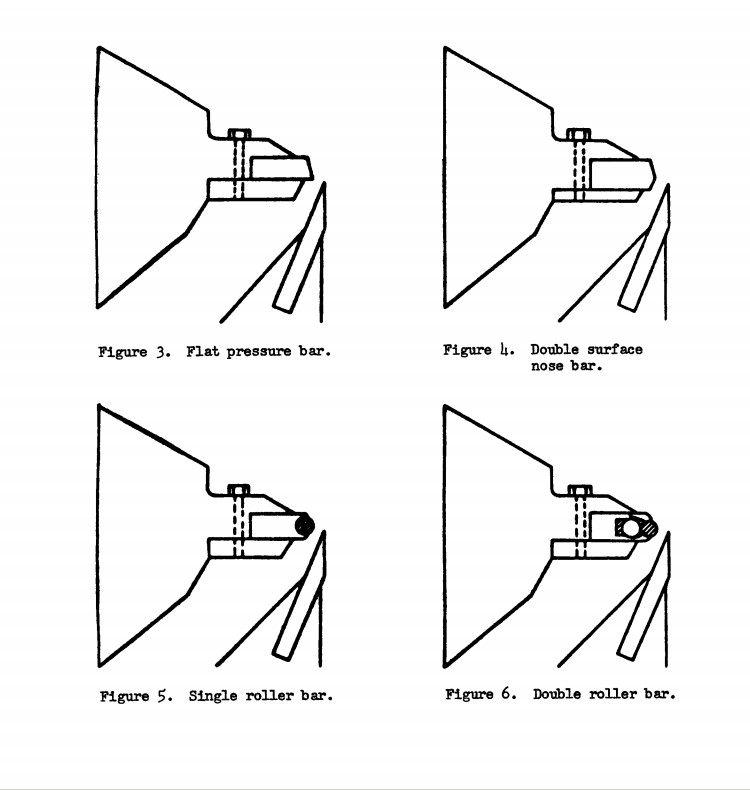
In the mid-1920' s George H. Osgood and Adolph Gaines devised and patented a roller bar. The single roller bar, Figure 5, is usually 5/8 inch in diameter
and turns at the peripheral speed of the bolt. The splinters and pitch get pushed through, thus reducing damage to the veneer. An improvement
upon this is a driven roller bar but its drawback is that its driving gear limits the minimum diameter of the core to about 1.5 inch more
than the diameter of the log chucks. To eliminate this loss in veneer yield, a double roller bar arrangement, Figure 6, was developed in which
the roller bar is rotated by a back up roll that is driven through a gear and synchronized motor assembly. The two bars are made up of
dissimilar materials—usually phosphor bronze, silicon bronze or manganese bronze for the roller bar and back up plate and steel for the
drive roller. |
||
|
|
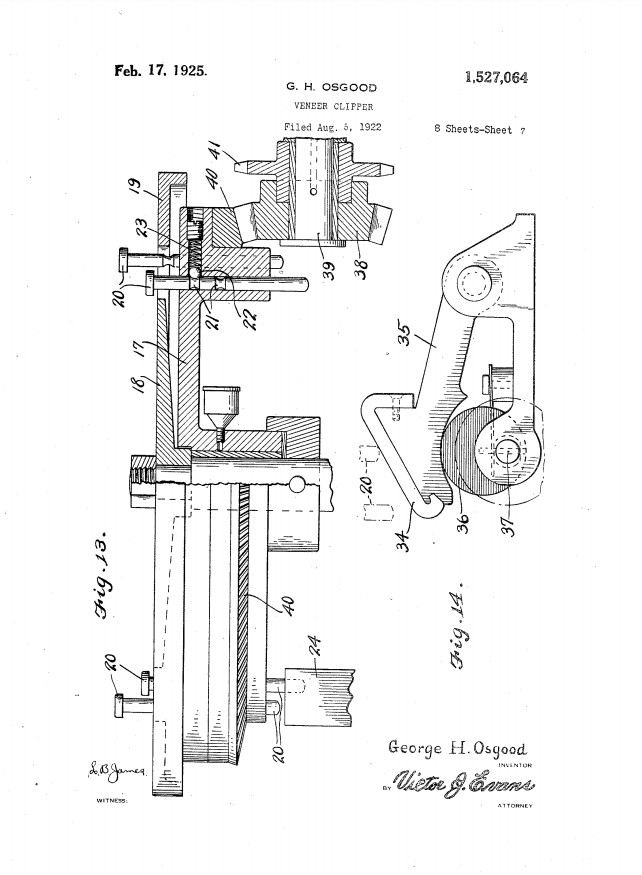
Veneer Clipper. To all whom it may concern. Be it known that I, George Henry Osgood,
a citizen of the United States, residing at Tacoma, in the county of
Pierce and State of Washington, have invented new and useful
improvements in Veneer Clippers, of which the following is a
specification. This invention relates to improvements in veneer
clippers, the general object of the invention being to provide means for
controlling the movements of the conveyor and the knife so that the
conveyor will be stopped and a knife actuated after a certain amount of
movement of the conveyor.
|
||
|
|
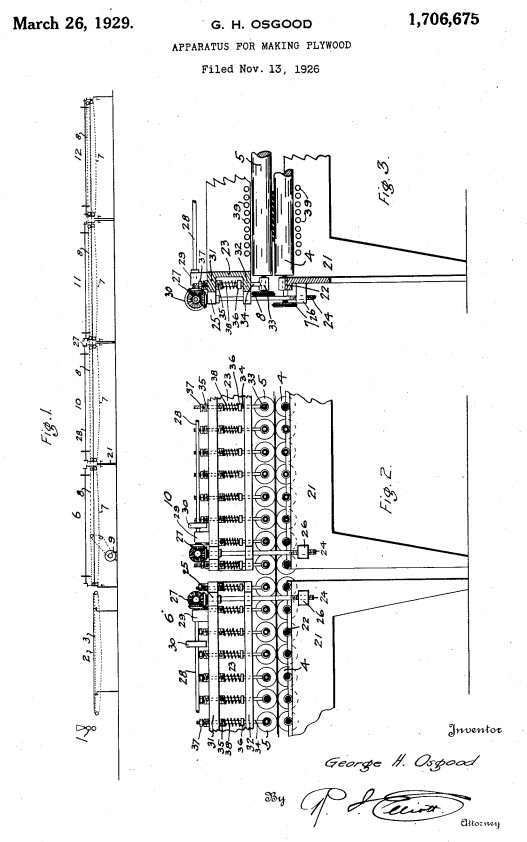
APPARATUS FOR MAKING PLYWOOD. In an apparatus for making plywood, the combination with a fixed frame; of a vertically adjustable frame mounted thereon ; a series of rotating feed rollers mounted in said fixed frame and adapted to feed the raw panel through the machine and to support Itself to the pressure therein; a series of vertical sleeves adjustably mounted In said adjustable frame; vertically guided rods mounted in and freely moving in mild sleeves; adjustable limiting nuts on the upper ends of said rods and adapted to engage the upper edge of said sleeves to limit the downward motion of said rods therein; compression springs mounted between the lower ends of said sleeves and collars on said rods, whereby the rods are resiliently forced downward; bearings mounted on the lower ends of said rods and a series of rotating pressure rollers mounted in said bearings, each pressure roller being positioned above one of said feed rollers and adapted to press the raw panel between it and said feed roller as It passes therebetween, and whereby the initial pressure of the feed roller is governed by the initial position of the sleeve in the frame and the limiting nut on said rod, and whereby adjustment for the thickness of the panel without changing the pressure of t he the roller thereon is attained by adjusting the adjustable frame.
|
||
|
Waterproofing Vegetable Protein-Base Glue. The object of my invention is to increase the water-resistance of protein-base vegetable glues, adapted to be used in the manufacture of wooden articles, whereby a glue which is of great strength and high water resistance, and which is cheap to make, may be obtained. A further object is to change the color of such a glue to a shade similar to that of the wood on which it is used, thereby eliminating the objectionable feature of the dark line, displayed by the layer of glue at the joint, common in such vegetable protein-base glues. My invention consists in incorporating a water-proof adhesive, not soluble in water into a vegetable protein-base glue. As a sample of such a glue compound, the mixture may be composed of a high protein-content vegetable meal, such as peanut meal, cottonseed meal, or linseed meal, with hydrated lime, sodium carbonate, sodoium silicate, an adhesive commonly known as rubber cement and comprising gum damar, commercial asphalt, sulphur, and soluble in carbon bisulplude. In place of the gum damar any of the resinous gums which are soluble in carbon bisulphide, suc as Gguttapercha, gum mastic, gum elemi, or Norway pitch maybe used if desired.
|
|||
|
|
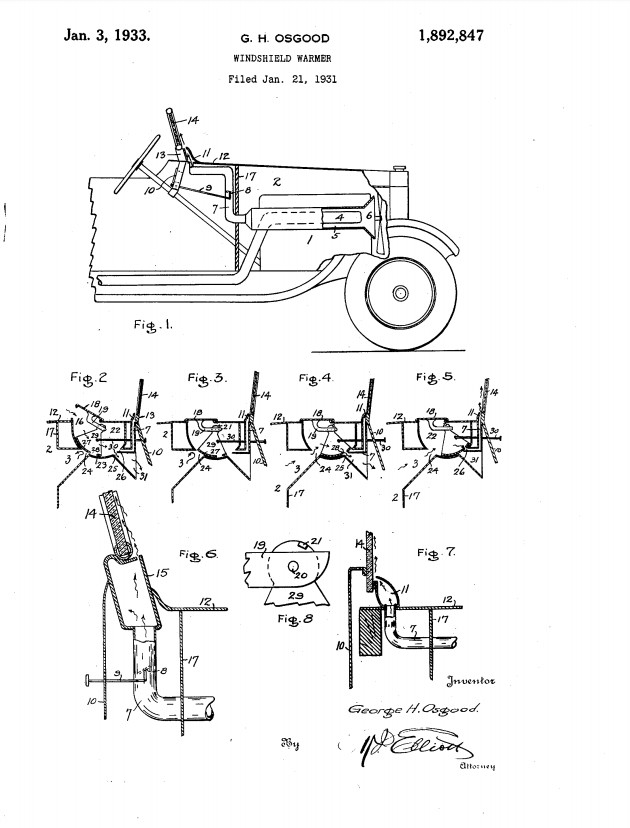
Windscreen Warmer. This invention relates to means for preventing the formation of frost on the windshield of an automobile, and has for its objects to direct a stream of warm air on the outer or forward side of the windshield, thereby preventing the condensation of moisture on the inside and the formation of frost crystals on the outside thereof, and melting any snow or ice which may have accumulated thereon while the machine was not in operation; to provide means to control the said stream of warm air; to provide means whereby the stream of warm air may be diverted into the car; to provide means whereby a stream of cool air may be passed into the car; and to provide a device which may be adapted to the many different makes of cars and which is simple to operate and effective in use.
|
||
|
|
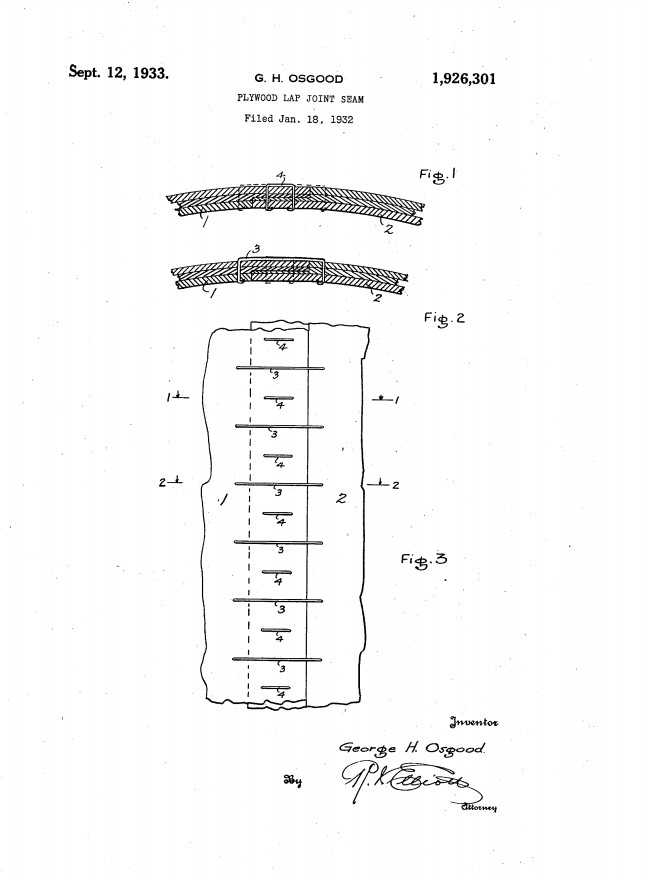
Plywood Lap-Joint Seam. This invention relates to means for fastening two wooden bodies together through
a Lap-Joint and has special reference to the seams between any two sections of a plywood barrel, such as
is set forth in my copendium application for patent for improvements in
barrels, filed under Serial Number 516,591.
|
||
|
|
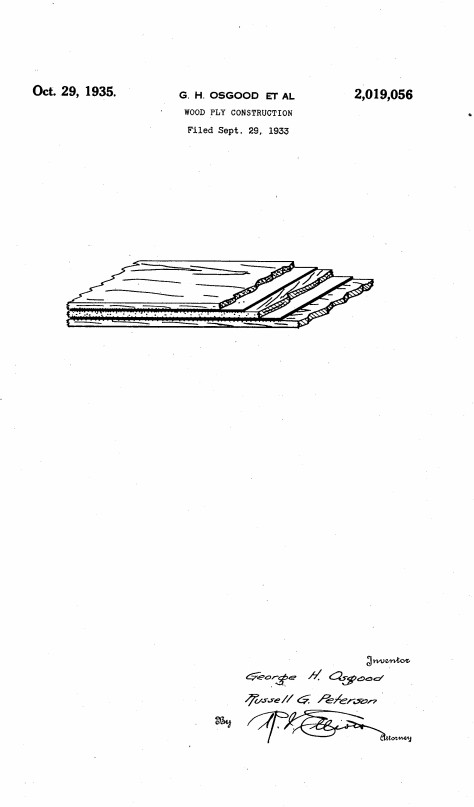
Wood Ply Construction. This invention relates to a new article of manufacture, and more
particularly to a veneer construction unit involving wood plies bound by
an adhesive using a vegetable hemi-cellulose- containing material
as a base. Our co-pending applications filed under Serial Numbers
652,692; 696,544; 696,545; and 698,428 all relate to adhesives analogous
to the herein-described adhesive.
|
||
|
Glue Base. This Invention relates to materials which maybe used as a base for making adhesives especially adapted for use in the manuacture of multiply fabrics containing sheets of wood, and/or paper, and for other uses, and which are useful also for making plastics and for other purposes as well. The invention comprises broadly a mixture of hemicagulose and coagulable or precipitable protein in which adhesive properties can be developed, such for example as casein, blood albumen, egg albumen, etc.and when properly made and treated it will have strong adhesive and cohesive properties approximating those of the protein, even though the protein is diluted by the hemi-cellulose because the adhesive and cohesive properties of the cellulose are not merely additive to but are coordinated with those of the protein. Hemicellulose derived from any suitable source may be used, and it may be incorporated as such and alone with the protein or mixed with other substances, provIded, of course that materials be not present which would have a very detri mental effect on the functioning of the product. For example. alphacellulose may be converted into hemicellulose and thiw while useful in my invention, is not a practical source of hemicellulose on account of the expense Involved in the transformation of the alphacellulose. Hemicellulose is a compopund part way between cellulose and starch, and it is present, generaly having fibrous structiure, in the hulls of any of the legumnes, verth, alfalaa seed, sweet peas, soiya beans, velvet beans, infact peas and beans of all kinds, coffee beans, horse chestnuts, and others, have In their hulls large amounts of hemIcellulose, these hulls generally containing not over fifteen per cent (15%) at the most and frequently not that much. of cellulose as distinguished from hemicellulose
|
|||
|
Casein Glue. A wood veneer casein glue having the desired body and working llfe, adapted to form a bond of the desired strength and water resistance, and comprising an admixture of an aqueous alkaline medium, isolated milk casein and sodium formaldehyde bisulphite. as separate ingredients, the amount of the water being at least four (4) times the amount of the casein by weight, whereby the amount of said sodium formaldehyde bisulphite may be at least about two and three-quarters percent (2¾%) to three percent (3%) of the amount of caseln by weioht.
|
|||
| Wood Veneer Glue. This invention relates to glues which are particularly adapted for use In gluing sheets of wood veneer together in the manufacture of multi-ply Panel boards. They are also adapted for making multi-ply paper board of card board, and other uses may be found for them. Certain glue problems arise In this industry due to the manner of manufacture. According to one method of manufacture the ply which Is to be the middle ply. say in a completed three-ply panel, is run between rolls to which the glue is fed and these rolls transfer It to both sides of the ply. The outside plies are then placed face to face against the middle ply, generally with the grain on the outside plies running crosswise of the grain of the middle one. In some instances the assemblies, each assembly consisting of three or any other desired number of plies with the glue between them. are stacked up until the stack Is sufficiently high.
|
|||
|
Waterproof Starch-Base Adhesive. In the manufacture of veneer panels it is frequently desirable to
hot-press such panels after the plies thereof are smeared with adhesive.
for the purpose of making the product strongly adherent and
water-resistant. The adhesive most commonly used for this purpose comprises a
blood-albumen base, and synthetic resin adhesives have been demonstrated somewhat
in the pest two years. Both of these types of adhesive are much more
expensive than vegetable-seed-residue glues which are now being used largely for
making stron, high water-resistant panels, the camparable cast of making panels with the
blood-albumen base adhesives and the synthetic resin adhesives running
anywhere from five to eleven times the cost of making a panel using a
vegetable-seed-residue glue. The vegetable-seed-residue glues. however
do not when hot-pressed. result in a panel haying as much adhesion and
water-resisting qualities as when blood-albumen or synthetic resin
edhesives are used.
|
HOME
Introduction|What's
New?|Index
of
Individuals|Surnames|Casualties
of
War
Location
of
Events|Chronology
of
Events|Occupations|Who
are
They?|