|
We, J. LYONS AND COMPANY, LIMITED, of Cadby Hall,
Kensington, London, W. 14, a British company, and WILLIAM GARRETT KNIBBS,
of Woodlands, Old Slade Lane, Colnbrook, in the County of Buckingham, a
British subject, do hereby declare the nature of this invention to be as
follows: This invention relates to testing devices for hermetically sealed
containers such as commonly employed for housing or preserving foodstuffs
and the like and has for its object to provide simple and efficient means
for indicating the presence of leakage in said containers.
As is known, containers for cake, for example, are usually first of all
filled with the desired contents and then soldered up prior to subsequent
transport. It is obvious however that should any irregularity occur in the
soldering process thereby resulting in leakage, there will be a consequent
deterioration of the contents due to the inefficient sealing of the
container.
The present invention consists in the provision of simple means whereby
such leakage is readily observed and disastrous deterioration incidentally
obviated. This is effected broadly by providing means for admitting a
supply of air under slight pressure to the interior of a container, which
has been sealed up in the ordinary manner, after or simultaneously with
which operation the container is innmersed in water or orther suitable
liquid. In-this manner the presence of any Ieakage will at once be
apparent owing to continuous formation in the liquid of bubbles issuing
from the source of leakage. Means are also provided for convenient
withdrawal of the container from the liquid to permit of final resealing
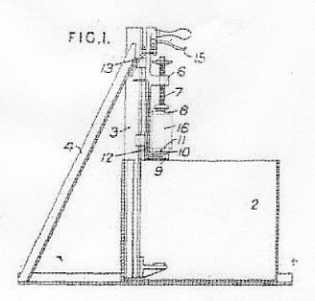
off and rectification. According to one embodiment. of the invention we
provide a tank containing water, in which is positioned a vertical member
having a suitable bracket at its lower end below the surface of the water,
while the upper end of the vertical member extends above the surface of
the water and is adapted to form the guideway for a clamp which may be
immersed in the water or maintained exterior to the tank as desired. The
clamp is provided with a regulating screw at the end of which is fitted a
disc of rubber or other resilient material. The lower jaw of the clamp is
also provided with a rubber or similar disc through which passes a fine
needle nozzle connected by means of a suitable tube to a supply of air
under pressure. At the head of the vertical member is provided a lever
adapted to control an air supply valve by Bowden wire or like mechanism.
In operating the device, an attendant places an already sealed container
upon the disc of the clamp provided with the needle nozzle, and by means
of the regulating screw the container is rigidly held between the two
jaws, at the same time causing the needle nozzle to penetrate through and
form a small aperture in the bottom of the container. The clamp is then
lowered on the vertical member until the container is comnpletely immersed
in the water. By means of the valve operating mechanism air is supplied to
the needle nozzle and enters the container and the presenee of any leakage
will be readily discovered owing to the formation of bubbles in the water.
The clamp and container can then be raised integrally from the water and
by slackening the regulating screw the removal of the container and
subsequent soldering of the small apperture formed by the needle nozzle
may be readily effected. It will be seen therefore, that we have provided
efficient means for testing the air tight conditions of containers by
totally submerging the container in liquid, whereby provision may be made
for preventing the liquid from entering or making contact with the
contents of the container.
Dated this 25th day of May, 1925.
A. A. THORNTON, Chartered Patent Agent, Quality Court, Chancery Lane,
London, W.C. 2, For the Applicants.
|