
I'm sure James would chuckle at this one, taken from the History of Tro
y, New York - "James Knibbs was the chief engineer of the fire departmen
t, and thus it has been said that calling an important man 'His Nibs' al
so originated in Troy."
__________
James is perhaps best well know for having invented and patented a devi
ce called the "Knibbs Run Around" and applied it to the Arbba Read Steam F
ire Engine. It's a pressure valve with the main objective of the inventi
on being to allow one, two, three or more discharge pipes or hoses to thr
ow streams of water from the fire engine at the same time, without any was
te of water or risk of injury or damage to it's operators or the engine it
self. It appears that at James' request, for experimental purposes, the de
vice was installed into an engine constructed by the Amoskeag Manufacturi
ng Company. Amoskeag then manufactured and sold engines containing Jame
s' invention for two years before James eventually applied for the paten
t.
James fought many court cases against the State Of New York to obtain mo
ney on his invention. He tried to get $26,000,000.00 and fought from 18
81 till his death. The family continued to fight for it after his death b
ut ended up settling for just $1,500.00.
__________
Unless an inventor is careful in deciding when and in wh
at way an invention is patented, the danger of infringement is greatly inc
reased, and court fights to protect the invention can easily become cost
ly and time consuming. A perfect example of this calamity is the ca
se of James and his fire engine relief valve, otherwise known as the "Knib
bs Run Around"./
James Knibbs was born October I827, in Somerton, England. At the age of th
irteen, his family immigrated to New York and settled in Troy where he lea
rned the machinist trade at the shop of Starbuck Brothers. In 1859, Knib
bs perfected an important pressure valve for steam fire engines. Until th
at time. there was no effective method for using more than one hose on ea
ch fire engine without wasting water and subjecting the operators to the r
isk of injury, The danger would arise when one hose was shut off and the e
xcess water was then diverted to the remaining open hoses. If two or mo
re hoses were shut off, the full force of water would flow into the remain
ing hose. which sometimes burst from the pressure.
The Knibbs Run Around relief valve solved this problem by diverting the ex
tra pressure to the receiving side of the pump. This meant that the pressu
re within the pump was the same whether one hose was in use or fou
r. As an experiment, he had the valve manufactured and placed on a steam
er for Troy`s Arba Read Steam Fire Engine Company In a series of` tests. T
he valve not only made it safer to operate different numbers of hoses, b
ut each stream of water was more powerful than the water streams of oth
er engines The fire company then appointed Knibbs as the first full time s
team engineer in the city of Troy and paid him the respectable sum of` fif
ty dollars per month. According to the Troy Times, Knibbs and his steam
er helped check the flames of the great Troy fire of 1862. which rapidly b
urned five hundred buildings.
In applying his valve to practical use, Knibbs made a grievous error. Rath
er than patent his invention fast, he gave the specifications to the Amosk
eag Manufacturing Company of New Hampshire so that it could install the de
vice on the Arba Read engine. Amoskeag found that fire engines with the Kn
ibbs valve installed performed so much better than those without the devi
ce that, unknown to Knibbs, the company immediately began installing the v
alve on every engine it produced. Since there was no patent to protect t
he device, municipalities and fire companies around the Northeast beg
an to adopt the design into their engines Curiously, this arrangement we
nt on for about two years before Knibbs finally applied for a patent in 18
64
To complicate matters, Knibbs licensed a portion of the patent rights to M
arcus Norton, who began a series of lawsuits against those who used the va
lve, One of the most public of these lawsuits was against the City of Bost
on.
Norton asked for $450,000 in damages but lost when the city proved th
at it had been purchasing Amoskeag fire engines before the patent was issu
ed. After that defeat. the patent rights were sold and resold to a stri
ng of investors until finally ending with Christopher Campbell of East Cha
tham, New York. Campbell commenced a milIion�dollar lawsuit against the Ci
ty of New York. Since Knibbs retained a portion of the rights to his paten
t, he also filed a series of lawsuits, These court cases eventually expand
ed to include over five hundred cities around the country.
The lawsuits did not end after Knibbs`s death on April I6, l901. His heir
s. as well as the heirs of Campbell`s estate, continued the fight with mil
lions of dollars at stake, which was widely publicized around the countr
y. Those municipalities that chose to fight, such as Boston and New York C
ity, prevailed, while others chose to settle out of court. When the lawsui
ts finally ended, they together constituted one of the largest patent figh
ts in United States history.
__________
The "Knibbs Run Around" wasn't the only device that James invented. He inv
ented at least two other devices that were also aimed at improvements to f
ire fighting.
The first was an Automatic Harness Suspender. From what I can understan
d, it's purpose was to simplify and thus hasten the activies required to p
reapre an engine for use, once it had reached a fire.
The second device was a Wire-Cutter. It was based on the design of a regul
ar garden priner for lopping small branches from the tops of trees. Jam
es redesigned it so that it could be used for cutting overhead electric wi
res that were interfereing with the operation of firemen accessing a birni
ng building.
Full details of these devices can be seen at
James' entry in the Inventive KNIBBS section of this web site.
__________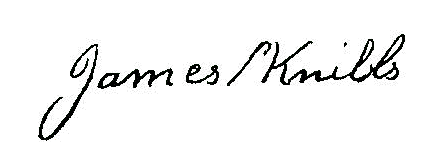
A sample of James' signature taken from his Patent from 1864.
__________
Please visit my Notable KNIBBS Page for James
__________
1849
It can be seen that James applied for Naturalization at Albany County, N
ew York, USA on 16 April 1849
__________
1850
James and Rhoda can be seen living at Rensselear, NY, USA at the 1850 cens
us. They appeared to be living at the home of Rhoda's parents:
Henry Harvey 49 Cooper Vt
Roxana Harvey 44 Vt
James Knibbs 23 Machinist England
Rhoda Knibbs 23 NY
Henry Buell Harvey 12 NY
Emily A Harvey 8 NY
__________
1855
In 1855, we see James in the New York State Census living at E.D. Wester
n, Glenville, Schenectady, New York:
James Knibbs Head Mar 27 Farmer England
Rhoda Ann Knibbs Wife Mar 27 Vermont
Joseph H Knibbs Son 3 Rensselear
__________
1860
In 1860 the Arba Read Steam Fire Engine Co. No. 1 was formed at Troy, a
nd a steam pumper was purchased from the Amoskeag Co. of Manchester, New H
ampshire. James was employed as the first fully paid engineer, hired to op
erate this highly technical piece of equipment. He was the engineer of t
he Arbba Read Co, between 1860-1873 and was paid a substantial wage of $50
.00 a month.
He invented a device called the "Knibbs Run Around" and applied it to t
he Arbba Read. It was a pressure valve designed to greatly improve the con
trol of water from the pump.
We can also see James still living at Rensselear, this time with Joseph, t
heir first child:
James Knibbs, Rensselaer, 30
Rhoda Knibbs, Rensselaer, 30
Joseph H Knibbs, Rensselaer, 10
__________
1862
He is listed as living at 47 Grand Division St.1850 to 1862. Then at 67 Gr
and Division St. till his death.
His house at 47 burned in the great fire of 10 May 1862.On that day, Tr
oy suffered its greatest loss by fire. A spark from a locomotive ignit
ed a covered wood railroad bridge to Center Island, and a strong west wi
nd drove the fire into Troy. By evening 508 buildings had been destroyed a
nd at least 8 persons lost their lives. The financial loss was $3.9 milli
on dollars.
The following is an extract from article that appeared in the Troy Tim
es of 11 May 1862:
1860
The Terrible F
ire of Troy. N.Y.
The fire originated in the bridge, by, it is supposed, a spark from a loco
motive. So rapidly did the flames spread, that several vehicles got off wi
th difficulty. The hurricane blew flames directly towards the city, and ca
rried the embers far back, setting a number of buildings instantly on fire
.
The spread of the flames was so fast and fearful that any attempt at a con
nected narrative would be in vain. At noon the danger was unexpecte
d. At 6 o'clock seventy five acres of the city had been swept over as by t
he hand of a
destroying fiend. Before sunset it was all over, and the streets - alas! S
treets of the tombs to all appearances - were quite passable. Even the pil
es of brick and crumbling walls had become cool.
The scene of desolation on River Street in indescribable. Franklin Squa
re can with difficulty be distinguished. The sign over the door of the Tr
oy City Bank is still standing, and the vault appears to be intact. All t
he valuables was
removed from the building before the fire approached. The fire was stopp
ed in River Street, at the pork store of C. Warner & Co. On the oth
er side of River Street the flames were checked in Greenman's furniture st
ore, and the Museum Building was this saved. The Read and Osgood steame
rs were stationed at this spot all the afternoon, and checked the flames.
James Knibbs, engineer of the Read, received a message from his wife th
at his house was in danger. His only reply was: "Let it burn � the city ne
eds my services and I must stay here." The company have raised between $1
00 and
$200 to partially reimburse him. The steamers worked until early morning.<
/i>
__________
1864
In 1864 he applies and is granted a patent for his invention. He appli
es it to another steam engine.
__________
1870
James can be seen at the 1870 census living at Troy, Rensselaer, Ney Yor
k, USA:
James KNIBBS 43 Engineer England
Rhoda KNIBBS 43 New York
Joseph KNIBBS 19 Machinist New York
William H KNIBBS 9 New York
Martha B KNIBBS 5 New York
Value of Real Estate $3,000
Value of Personal Estate $600
Locality: 13-WD TROY M593-Roll: 1084 Page: 352 State: NY
__________
1875
In 1875, James was living at Ward 13, Troy, Rensselaer, New York, United S
tates :
James Knibbs Head Mar 38
Rhodeanna Knibbs Wife Mar 33
Joseph H Knibbs Son 24
William H Knibbs Son 14
Martha B Knibbs Daur 10
__________
1875
From the Chicago Daily Tribune., August 06, 1875:
Self-Propelling Fire-Engine
Troy Press
Fire Commissioners Hotchkin and Ranken, who, togetber with Capt. Smith a
nd Engineer Knibbs, visited Menchester, N. H., to purchasa a new steamer f
or the Read, returned this morning. Messrs. Hotchkin and Ranken have purch
ased a second-class self-propeller for $4,800, 'subject to the approv
al of tho Board of Fire Commiesioners, who meett to-night. Tho visitors we
re shown through the works at Manchester and wore given an opportuni
ty to become acquainted with the working of the self-propelling flre-engin
e. The propeller consists of two enless chains which run over drums on t
he hinder axle and over shafts projecting from the fly-wheels. The rear wh
eels axe very heavy, and the tires are studded to prevent slipping when t
he steamer is ancending a hill. Yesterday, one of this class of steamers w
as taken from the works to the race-course at Manchester, where it run a m
ile in three minutes. It was afterwards tensed on ordinary roads, and in a
scending a hill, steeper than any in Troy. It went up hill faster than eit
her of the four Trojans could. Nino of this class of steamers have been ma
de and sold; two are in New York, two in Brooklyn, one in Boston. and o
ne lin Detroit. The steamer which was tested yesterday can be finish
ed in about a month, but it is considered too heavy for Troy. If the Fi
re Commissioners ratify the bargain made by the Committee, a second-cla
ss steamer will be built within three mouths for this city ut a coat of $1
,800. On their way home the Trojans stopped in Boston, and looked at the s
elf-propellor in use there. It gives great satisfaction. In going to a fi
re the tender is hitched behind, and no horses are used at all, saving t
he cost of buying horses, and of replacing them when worn out, and their k
eeping, and of the wages of a driver. Sixty pounds of steam is kept up con
stantly at a cost of 50 cents per diem. It looks as if the days of horne-f
icall in our Fire Department were numbered. The cost of keeping the steame
rs supplied with horses has been one of the largest items of expense, A te
arn will last not to exceed two years, when they must be sold for almost n
othing and another team purchased ; besides it costs about $9 per week f
or each steamer to keep the horses, and $60 per month for a driver. The se
lf-propeller costs as much more than an ordinary steamer as a team of hors
es, and eats nothing and wants no driver.
__________
1878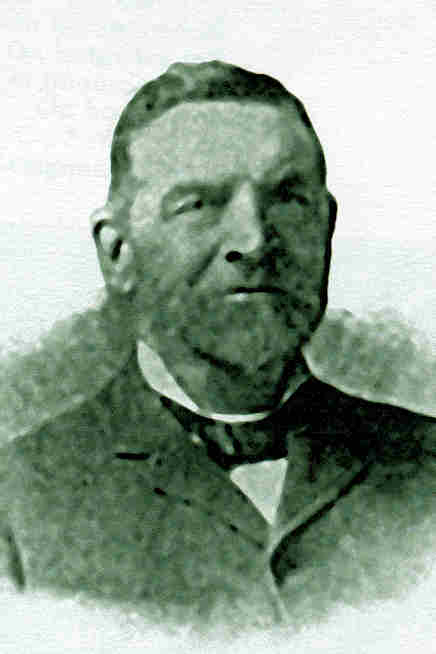
There is a picture of him and several pages of written information in Arth
ur Weise's book, "Troy Firemen and Fires" This book was written in 1878.
__________
1880
From the 1880 Federal Census for Troy, Rensselaer, New York, we can see Ja
mes, aged 53, an Engineer, living with his wife Emma aged 29, and two of h
is children, Martha aged 16 and William aged 19. William is also list
ed as an engineer. They were all living at 66 North 3rd Street.
James Knibbs Head 53 Engineer England
Emma Knibbs Wife 29 Keeping House New York
William Knibbs Son 19 Engineer New York
Martha Knibbs Saur 16 At Home New York
__________
1881
From the Utika Morning Herald, Tuesday November 3rd, 1881:
Made a Fortune Easily:
Captain D.S. Goodell, a retired sea captain, of Searsport Me., advanced mo
ney to enable James Knibbs, of Troy, N.Y. to prosecute a suit for an infri
ngement against his fire engine valve patent, on condition that he shou
ld have a certain percentage of the damages recovered, if any. Captain Goo
dell's share of the winnings this far looks up to $750,000
__________
1883
From the New York Times, Saturday 31 March, 1883
DECISION RELATING TO FIRE-ENGINES:
Boston March 30 - Judge Lowell has rendered a decision on the bills of com
plaint of the cities of Concord, Dover, Portsmouth, Manchester and Nash
ua against Marcus P Norton. Trustee and others in the United States Cour
t. The complainant cities sought to restrain the defendants from prosecuti
ng certain suits for damages for the use of an improvement in steam fire e
ngines known as the Knibbs patent. The court refuses the injunction pray
ed for saying that it cannot undertake to decide upon the validity of t
he patent or restrain the present case at law unless some purely equitab
le defense is made out which would not be equally available at that action
.
From the New York Times, Friday 4 May, 1883:
The Knibbs valve suits against four of the cities of New Hampshire a
re to be tried at Portsmouth next week. and an old steam fire engin
e, to be used in evidence, has been taken there from Vermont. The engine h
as been in existence since 1859 and is said to contain an arrangement cove
ring the principle of Knibbs's patent, this antedating it.
From the New York Times, Thursday 26 July, 1883: (General Notes)
It has cost the New Hampshire cities $20,000 to contest successfully the K
nibbs valve suits, and the city council of Dover asks an itemized bill.
From the New York Times, Sunday 23 December, 1883
A PATENT SUIT DECIDED.
Boston, Mass, Dec 22. - In the United States Circuit Court today before Ju
dge Nelson in the patent suit of Marcus P Norton and another against the c
ity of Boston, which has been on trial for several days, the jury return
ed a verdict for the defendant. This was an action to recover $450,000 f
or an infringement of what is known as the Knibbs patent for improveme
nt in steam and fire engines, consisting of a short pipe and valves whi
ch control and regulate the supply and discharge of water in the hose. Th
is is a case of great importance to all cities and towns using steam fi
re engines, as it was the first of a series of suits for the recovery of r
oyalty on the Knibbs valve which the jury has declared by its verdict to h
ave been antedated.
From the Philadelphia Ledger, December 25, 1883
THE KNIBBS VALVE PATENT SUITS
It is expected that the old Philadelphia, the first steam fire engine whi
ch was recently taken to Boston as evidence in an important patent suit ag
ainst that city, will be returned to its owners, the Insurance Patrol, to-
day or to-morrow. The suit was by Marcus P> Norton and others, Assigne
es of James Knibbs of Troy, N.Y., who claimed to hold the original pate
nt for a relief valve, which was extensively used upon its steam fire engi
nes by the city of Boston and elsewhere throughout the country. In the for
mer city alone royalties claimed by the plaintiffs amount to $450,000. T
he part taken in the case by the old engine Philadelphia was interestin
g. It seems from a statement of those who accompanied her to Boston that s
he was wanted to prove that the valve, for which the complainants claim
ed the patent right, had been used on her two or more years before the pat
ent was issued. During the trial the court and jury adjourned to the Bost
on Commons to witness a practical demonstration of the working of the val
ve of the old engine with that of one of the latest construction. The resu
lt, it said, was amazing, as the old engine, which many feared could not s
tand the strain, threw a larger stream with two pieces of hose than the ot
her did with one. The valves, it was stated, were shown to be the sam
e, to the satisfaction of the jury, and a verdict for the city of Boston w
as rendered on Saturday last. Among those who testified with referen
ce to the valve of Philadelphia was Jacob Neaffie, builder of the engine a
nd member of the firm of Neaffie & Levy; Joseph L. Parry, the designer: Ri
chard Warren, an engineer of the present Fire Department, and George Kurt
z, the original engineer of the Philadelphia, who conducted the practic
al test at the trial, and who managed the engine over 20 years ago, when h
er usefulness was exhibited in the city of Boston, near the same spot, a
nd a prize of $600 won.
__________
1889
From The Catskill recorder., February 15, 1889:
Superintendent Knibbs of the F. A. T. has invented a steel cutter with whi
ch eight strands of ordinary telegraph wire can be cut at a time. It is so
mewhat of the tree-trimming machine style .
__________
1890
James appears in the 1890 Troy, New York City Directory with the followi
ng entry:
Name: James Knibbs
Location: house 2194 Sixth Avenue
Occupation: supt. fire alarm tel.
City: Troy
State: NY
From the Observer, 2 May 1890:
Patents Granted
The following list of patents granted to citizens of eastern Now York is e
xpressly reported for the WASHINGTON COUNTY OBSERVER by H. Judd Ward, soli
citor of patents and counselor In patent cases, Union National Bank Buildi
ng, Troy, N. Y.
Adelbert Chambers, assignor to J. A. Manning, Troy, apparatus for treati
ng vegetable imbalances; Harry Comstock, Fulton, pipe cutter; George Coope
r, assignor of one halt to C. Cooper, Bennington, Vt,, trimming attachme
nt for sewing machines; James Knibbs, Troy, wire cutter; Hiram N. J. Mansf
ield, Mulone, machine for grinding mill rollers;
Whole number of patents granted 405, of which 9O were issued to residen
ts of Now York state.
__________
1891
The following is an excerpt from Troy's One Hundred Years 1789-1889, compi
led by Arthur James Weise, M. A., and published in 1891 by William H. You
ng of 7-9 First Street in Troy:
"Arba Read Steam Fire Engine Company, No. 1, informally organized in Novem
ber, 1859; constitution and by-laws adopted December 19th; first office
rs elected January 9th, 1860. First engine received March 28th, that yea
r. The engine-house, next north of the present [i. e., 1891] one, on the n
orth-west corner of Third and River streets, was built in 1860; the prese
nt one was erected in 1875. The "law relating to the establishment and org
anization of a steam fire company of the city of Troy," passed by the Comm
on Council, February 16th, 1860, designated the members of the Arba Read S
team Fire Engine Company, No. 1, as firemen of the city, limiting th
em to sixty persons. On May 24th, 1860, a span of black horses was purchas
ed for the company. On January, 1862, the trustees transferred the apparat
us and property to the city. James KNIBBS was appointed engineer of the co
mpany February, 1860, which position he filled until December 1st, 1863."
__________
1891
From the Troy Daily Times, 8 October 1891:
HOME MATTERS
�Last night the electric-light and fire-alarm telegraph wires came in cont
act In several places on River and Fulton Streets, and two or three pol
es were set on fire. Several blows were sounded on the fire-alarm at inter
vals. This morning Superintendent Knibbs started out to investigate the fi
re-alarm system, to see if It bad been damaged. Superintendent found b
ox 36 burned out partly. The alarm was caused by the burning-off of a brac
ket fastened to a tree on Broadway. near Fifth avenue.
__________
From Le Roy Gazette, 28 October, 1891:
Made a Fortune Easily
Captain D. S. Goodell, a retired sea captain, of Searsport, Me. , advamc
ed money to enable James Knfbbs, of Troy, N.Y.. to prosecute a suit f
or an infringement upon his fire enginee valve patent, on condition th
at he should have a certain percentage of the damages recoveredl, if an
y. Captain Goodell's share of the winnimgs thus far foots up $750,000 -
-- Bangor Letter.
__________
1891
From the Galveston Daily News, (Houston, TX) September 06, 1891:
Mr. Knibbs, the Millionaire.
NEW YORK, Sept 5.- The chief of Troy fire department, James Knibbs, invent
or of the relief valve for fire engine pumps, won his suit against the ci
ty of New York for using his device since 1864. The amount in nearly $2,25
0,000. Five hundred similar cases are pending against other cities in t
he United States, involving $15,000,000, all of which Knibbs will probab
ly win.
__________
1895
From the Olean Democrat 12 April 1895, New York
GREAT PATENT CASE. What is probably the largest patent case ever kno
wn in the courts of this country is being conducted by Judge Hadlock, t
he Boston lawyer. The case is that of Christopher C Campbell, assign
ee in trust, against the city of New York, for alleged infringement of pat
ent, and the amount involved is $15,000,000. Up to the present time abo
ut $200,000 has been spent in litigation,. It has been in the courts for n
early 20 years. In 1864 a patent was granted to James Knibbs for a valve c
ontrolling water pressure in fire and other steam engines, and this val
ve has since come to be used wherever steam fire engines are in servic
e. - Boston Journal
From the Post Standard, Syracuse, New York, Friday December 16 1904
Decision in New York City Suit is Far Reaching - CASE IN COURTS 30 YEARS.
Brought by Knibbs Heirs for Alleged Infringement by Patent of Device Emplo
yed on Fire Engines
A decision handed down yesterday by the United States Circuit Court of App
eals relieves the city of Syracuse for liability of an infringement upon t
he Knibbs churn valve, which Chief John P Quigley of the Fire Department s
aid last night, is an appliance found on every fire engine in use.
The suit has been in the courts nearly 30 years and involved more than $15
,000,000. It became known as the "Campbell Patent Suit" and was brought ag
ainst the city of New York in 1877 by the heirs of Knibbs, an engine
er in the Troy Fired Department, inventor of the appliance. The device w
as adopted by the New York city fire department in 1865 and soon aft
er in almost every other large city where steam fire engines were in use.&
nbsp;
The decision is in favor of the defendant.
__________
1897
From a document headed Landmarks of Rensselear County, by George B Anderso
n, published 1897, Syracuse, N.Y.:
Knibbs, James, was born in England, October 5, 1827, and is a son of Jose
ph and Anna (Bennett) Knibbs who came to this country in 1840 and sett1
ed in Albany. His father was for thirty years janitor of the Albany Medic
al College. He died in 1874 and his wife died in 1884. James was educat
ed in the common schools and came to Troy in 1848 and learned the machinis
t's trade in Starbuck Bros. shop in Troy, and worked at his trade until 18
60, when he became connected with the Arba Reed Steamer Company. He took c
harge of the engine until 1888, when be was appointed superintendent of t
he Troy Fire Alarm telegraph, which position he has since held. He is a me
mber of Mount Zion Lodge F. &A.M., of which he is a past master, of Apol
lo Chapter. Bloss Council, Apollo Commandery, and is also a member of t
he Masonic Veteran Association, and is the present treasurer. He has he
ld all the offices in Athenian Lodge of Odd Fellows and in the Encampme
nt and is the present treasurer of both bodies. In 1850 he married Rho
da A. Harvey of Troy who died in 1876. His present wife is Emma Laws of Co
hoes, whom he married in 1879. Mr. Knibbs has one son and one daught
er by his first wife, viz.: William H., who is in the drug business at Sti
llwater and Mrs. Frank B. Marks, of Elmira, N. Y.
__________
1900
From the New York Journal and Advertiser, June 6, 1897:
KNIBBS'S MANY INVENTIONS
Had James Knibbs held onto the patents that he obtained for his inventio
ns he would now be In a fair way to beeome a millionaire. He Is a veter
an employe of the Fire Departtnent of Troy. and probably a few thousand do
llars would express his present possessions after an honorable and faithf
ul service that began before the civil war. When the first steam fire engi
ne came to Troy he was selected for its engineer. That was in March, 186
0, and he continued In that capacity until about a dozen years ago, wh
en a promotion came and he was elected superintendent of the fire alarm te
legraph system. He has since been re-elected annually. Every one in Troy k
nows "Jim" Knibbs and his horse "General Coxey." Daily they are seen abo
ut the streets together wherever a break in the fire alarm system calls th
em. His services in the Troy Fire Department have been rendered with ra
re devotion to duty and often at great personal sacrifice. At the ti
me of the big fire In 1862, when 507 buildings scattered over seventy-fi
ve acres in the central section of the city were burnt In the short spa
ce of six hours. Mr Knibbs was one of the hardest workers In the endeav
or to save the whole city from, destruction. When he was working at the fi
re his wife came and told him his own house was burning. "Let it burn
." he said, and so it did. During the years of Mr. Knibbs's connection wi
th fire circles he naturally noticed ways In which the service needed Impr
ovement, and applied his talent in that direction. The result has been sev
eral contrivances that have proved of value, although not of the pecunia
ry profit to their deviser that their utility deserved. Among' the numb
er were a cutter for electric wires, deviser thnt their utility deserve
d. Among the number were a cutter for electric wires, an attachment for t
he harness of horses In steam houses, and next important of all, the siame
se fire hose coupling. Long ago the idea of the hose coupler came to him a
nd he at once began experi-menting. What he wanted was a valve that shut o
ft the water In the nozzle attached to the hose pipe, his plan being' to o
bviate unnecessary loss of property by needless drenching of fires. He con
tinued working on the idea until May, 1864, when he perfected and patent
ed the "run around" nozzle. The value of the contrivance was recognized, a
nd fire departments In the principal cities soon commenced to use the val
ve without regard to the rights of the patentee. This precipitated many su
its, Mr. Knibbs's Interests being looked after by Marcus P. Norton, a we
ll known patent lawyer, of New York. The legal expenses finally became mo
re than the meagre pocketbook of Knlbbs could stand and he assigned the la
rger share In the patent to Christopher G. Campbell, a former conduct
or on the Boston & Albany Railroad, whose home Is in Cheshire, Mass. The m
atter has since been in numerous courts, with varying verdicts. Five New E
ngland cities were among the defendants�Lawrence. Mass.. and Nashua, Conco
rd. Manchester and Portsmouth, N. H. The Button Fire Engine Company was an
other defendant, but the final action was a suit against the city of New Y
ork.
__________
1900
From the 1900 census Vol 220 ED 71, Sheet 2 line 96:
James Knibbs b. Oct 1827 age 72, married 22 years (m. 1878) born in Englan
d, mother and father born in England, Year of Immigration 1840, 60 y
r. in US, Naturalized, Superintendant (Fire Alarm), Owns house, free of mo
rtgage. Grand St, 84.
Married to Emma Knibbs v. Dec 1850, age 49, born in NY, mother & father bo
rn in Virginia.
In 1900, the address may be 68 Grand St.:
Knibbs, James, Head, born Oct 1827, age 72, married 22 years, self and par
ents born in England, immigrated in 1840, illegible scribble in the citize
nship column, occupation: "Supt (Fire Alarm)", able to read, write, and sp
eak English, owns his house free of a mortgage.
Knibbs, Emma, Wife, born Dec 1850, age 49, married 22 years, 0 children, b
orn in New York (state), parents born in Virginia, able to read, write, a
nd speak English, no occupation.
__________
1900
From The New York Times, December 13, 1900:
CITY AS AN INFRINGER
a judgment has been entered against the City of New York for $818,074.8
2, with interest from May 14, 1897, being the amount of damages awarded t
he trustee of the successor of the assigneeof an inventor named KNIBBS f
or the use by the city of a device applicable to steam fire engines. The p
atent to KNIBBS was granted in May, 1864, and is very much broader in i
ts scope than The present rules of the Patent Office would permit. The inv
ention is undoubtedly useful. It consists of a relief valve in the dischar
ge nozzle of the pump by which the water discharged, when impelled under g
reater treasure than the hose will carry, opens a clog-pass for itself a
nd is returned to the suction pipe. The object of the device was to perm
it any of the streams discharged by a steam-fire engine to be cut off with
out interfering with the other streams, or bringing an undue strain upon t
he hose linen. It was undoubtedly a useful improvement in attachments f
or power pumps;
The same result could be reached by a dozen mechanical devices wholly diff
erent from that used. Mr. KNIBBS'S patent was drawn, as to its tint clai
m, to cover the principle of the invention, independent of the specific me
ans by which the result was attained. Such a claim would be impossib
le of allowance under the rules of practice now enforced, and a patent whi
ch should contain such a claim would not be sustained by the courts. Nothi
ng is better established in Patent Office practice than that an invent
or is entitled to his invention; That to
establish his invention he must show a. way of attaining the result descri
bed, and that if he wants to cover other means he must take out other pate
nts.
The principle underlying the invention of KNIBBS was applied to all ste
am fire engines as a necessary detail of construction. In this way it w
as adopted and used by the New York Fire Department. Suits fo recover wh
at the owners of the patent alleged to be due them were begun in 1877. T
he details of the litigation are unimportant. In 1897 a decision sustaini
ng the patent was obtained. and a Master appointed to determine the amou
nt of profits. Those for whom it has interest will find it indexed as CAMP
BELL vs. The Mayor, &c., 28 Blatchford, 67, 9 Fed. Rep. 500; 47 Fed. Rep
., 515. The. Master, after a critical examination, reported that the ci
ty had profited by the use of the invention to the amount of $28,886 Th
is was probably fair and just - it was certainly liberal. It probably repr
esented a good many times what the inventor would have been extremely gl
ad to take for the local rights, but that is of no consequence. Exceptio
ns were taken by both parties. These exception, were argued before Judge W
HEELER in the United State Circuit Court for the Southern District of N
ew York. who, on the 14th of May, 1897, rendered a decision to the effe
ct that, by the use of KNIBBS�S device, the city had saved $183,394.
32 in hose,
$28,336 in machinists� wages, and over $606,344 in salaries of men. The s
um of these colossal economies, $818,074.32, was the award. This Judgmen
t. though rendered three and a half years ago, has just been entered. Inte
rest and costs will bring the amount for which the city stands as a judgme
nt debtor well over a million dollars.
It is not the province of a newspaper to review the opinion of so learn
ed a jurist as Mr. Justice WHEELER. We may respectfully suggest, howeve
r, in the language of Solon Shingle, that $818,074.32 "is a lot of money
," especially when rounded out with costs and interest for
three and a half years. The lay mind is incapable of appreciating the judi
cial acumen which is capable of weighing economies practiced on so lar
ge a scale in a balance so delicate as to determine a saving in the it
em of hose alone of $183,394.32 during a period of fifteen years and fo
ur months.We think the award of the Master, $28,336 was extremely libera
l, and that the representative, of the city were warranted in
taking exception to it as excessive. Had it been sustained it would have b
een abundantly compensatory to the owners of the patent, who long ago exti
nguished the rights of the inventor in the outcome of the suit against. N
ew York when $10,000 was accepted from the City of Troy for the local rig
ht of use, we incline to the belief that the United States Circuit Cou
rt of Appeals will promptly reverse Judge WHEELER and confirm the repo
rt of the Master. The maintenance of a Fire Department is not a gainful oc
cupation for the city. It is extremely doubtful if any of the theoretic
al economies discovered by Judge WHEELER were, or could be realized. It wo
uld be equitable for the city to pay an
amount representing a fair royalty upon the device claimed in KNIBBS�S pat
ent, and then to recover the same from the companies building steam fire e
ngines which appropriated the device without license and embodied it in th
eir
constructions.
We believe that Emma had a sister named Lizzie S Laws (1848-1910) marri
ed to Luhr Eggers (1847-1916). They had a daughter Anna L Eggers (1876-195
4) and another daughter named Jennie born in about 1874.
Three of these names appear on the Knibbs Monument at Oakwood Cemetery, Tr
oy, Rensselaer County, New York, USA.
__________
The above three can be seen at the 1880 census living at West Troy, Alban
y, NY:
Luhr EGGERS Self Mar 32 Manuf. Of Bone Dust NY
Elizabeth S EGGERS Wife Mar 31 NY
Jennie M EGGERS Daur 6 NY
Annie L EGGERS Daur 4 NY
We can also see from the 1880 census return that Luhr's parents Luhr and M
ary Eggers were also living at Troy NY with his siblings Christopher, Ann
a, Edward and Fred. Luhr Eggers Sr. was a Tallow Handler by trade, and Chr
istopher also worked in the Tallow Factory. Luhr's parents were born in Ha
nover, Germany.
__________
From the Daily Times,Troy, 14 August 1896:
The People of the State of New York. To Richard V. Freeman, Mrs. Willi
am H. Hamiltom, Margaret Mead, Robert J Laws, Eliza Eggers, Emma L. Knibb
s, heirs-at law and next of kin of JEANETTE MOSHER, , late of the Ci
ty of Troy, the county of Renaselsear, deceased.
Greeting: You and each of you are herby cited and required personal
ly to be and appear before our surrogate of the county of Rensselaer, in t
he Surrogate's Court, In the city of Troy, is said county, on the 21st d
ay of,Septetuber. 1896. at ten o'clock In the forenoon of that day, to att
end the probate of the last will and testament of the said deceased, whi
ch will then be offered for that purpose, by James Knibbs, the executor mu
ted in the said will, who has applied to said surrogate, for the pro
of of said will, which relsates to real and personal estate, and that if a
ny of the persons interested be under the age of twenty-ine years, they a
re required to appear by their guardian. If they have one. or if they ha
ve none, that they appear and apply for one to be appointed. or in the eve
nt of their neglect or failure to do so, a guardian will be appointed by t
he surrogate to represent and act for them in the proceeding.
IN TESTIMONY WHEREOF, we have caused the seal of office of our said surrog
ate to be hereunto affixed.
(L.S.) WITNESS, Hon. Albert C. Costock. surrogate of said county. at t
he city of Troy, the 31st day of July. 1896.
CLARENCE E. BETTS. Clerk of Surogitte's Court.
LONG & MAXWELL. Attorneys for pettitionrt
13 10-2 State Street, Troy, N.Y. State street. Troy, N. Y.
__________
In 1910, at 608 Grand St.:
Knibbs, Emma, head, age 54, widowed, 0 children, born in NY, parents in V
A, able to speak English, occupation: Proprietor of a lodging house.
There were five lodgers enumerated.
__________
From the Troy Times, Thursday October 23, 1930:
Emma Laws Knibbs, wife of the late James Knibbs, died this morning at h
er residence, 1809 Fifth Avenue, after a short illness. Mrs. Knibbs was bo
rn in Colonie. The survivors include three nieces, Miss Anna L. Eggers a
nd Mrs, Alson Lusty, both of this city, and Mrs. E.G. Saunders of Averi
ll Park. The funeral will be strictly private from the funeral home of Rob
ert Morris & Sons, with Rev. Dr. D. R. Wilcox officiating. Mrs. Edith Cleg
horn Weaver will sing during the service and the interment will be in Oakw
ood Cemetery.
__________
From the Troy Times, October 24, 1930:
KNIBBS - In this city, Oct. 23, 1930, Emma Laws, wife of the late James Kn
ibbs.
Funeral strictly private from Robert Morris and Sons' Funeral Home, Interm
ent in Oakwood.